OceanView Blog · 4-minute read
Two-Point and Multi-Point Locks: Why a Universal Latch Is Not Always a Substitute
Need this looked at around Daytona Beach? Sliding Door Lock Repair and Replacement — request service or call 386-202-1678.
OceanView Editorial · Pen name: Drew Kessler · 4-minute read
These guides use editorial pen names. Read how this blog is prepared.
A two-point or multi-point sliding-door lock is a system of interacting parts, not simply a latch with a different-looking handle. Replacing it with a universal single-point mechanism may leave the intended locking arrangement incomplete. Identify the door and full mechanism before selecting a substitute.
Count engagement points, not decorative features
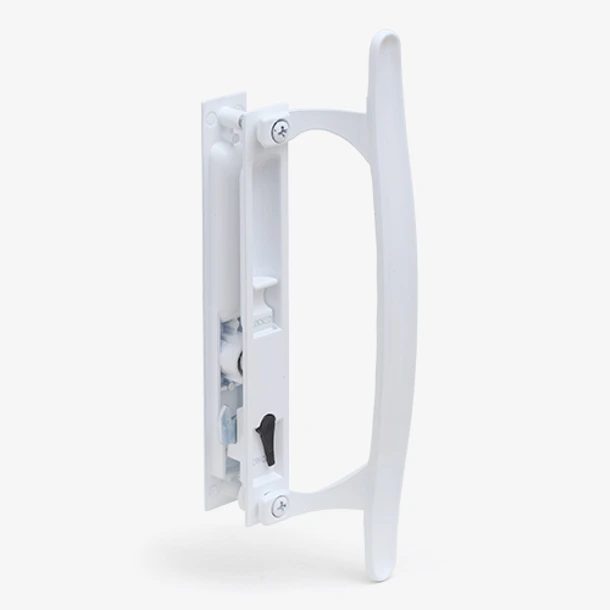
The visible lever does not show how many points engage when the door locks. Some mechanisms operate more than one locking feature through the same handle. The provider should identify the actual engagement arrangement rather than infer it from the faceplate's appearance.
ES Windows lists a two-point lock for its ES-SGD6100 sliding-door system. That is a specific manufacturer configuration, not evidence that every impact slider uses the same mechanism. Product identification remains essential before comparing replacement parts.
Compatibility extends to the receivers
The mechanism's engagement features have to meet compatible receivers in the intended panel position. Spacing, movement, orientation and mounting matter together. A replacement that fits the opening in the stile may still fail to engage the original receiver arrangement.
Ask whether the proposal preserves the door's intended locking system. A provider should explain any compatible replacement and necessary associated components. “Universal” on packaging does not establish compatibility with the identified mechanism and door.
One functioning point does not prove complete operation
For an illustrative example, the handle moves and one engagement point catches, but another does not reach its receiver. The door may feel partly latched without demonstrating the full intended function. The technician should investigate the complete mechanism and alignment.
Do not dismantle the lock or use improvised tools to move concealed engagement features. Describe whether the lever completes its normal movement and whether the symptom changes with panel position. Stop forcing a lever that resists ordinary operation.
Alignment belongs in the diagnosis
A shifted or unevenly closing panel can affect more than one receiver relationship. Moving individual receivers without assessing the panel can create a confusing series of compensations. Check the supported panel position and closing contact before treating each point as a separate failure.
This does not rule out genuine mechanism wear or damage. It separates a locking-hardware fault from a positioning problem that can imitate one. Both may need attention, and the written scope should distinguish them when applicable.
Avoid unsupported security promises
The number of locking points alone does not establish a complete security or impact-performance rating. Door construction, glazing, installation and the documented configuration also matter. Do not assume an aftermarket conversion inherits the original system's published performance.
Ask the provider to identify the supported hardware and any relevant manufacturer documentation. A repair estimate should explain function and compatibility without promising that a particular generic lock makes every slider hurricane-rated or burglary-proof.
A complete locking demonstration
After work, observe normal closing, handle movement and the intended engagement arrangement. Include keyed operation where part of the installed system. Ask the technician to confirm the relevant points rather than rely only on a tug at the handle.
Keep the mechanism identity and associated receiver information. If only some components were replaced, record which remain. Those details can prevent a later service visit from ordering another incompatible part based on the visible handle alone.
Questions homeowners ask
Does every impact door have a two-point lock?
No universal lock arrangement follows from the impact label. Identify the product and configuration. Manufacturer examples show particular systems, not a rule covering every Florida door.
Can a single-point latch replace a multi-point system?
Only a supported, compatible arrangement can answer that for the specific door. Do not assume a generic substitute preserves the intended function simply because it can be mounted in the stile.
What should the written estimate identify?
The mechanism, compatible receivers or associated parts, any alignment work and the intended final functions. It should distinguish a complete replacement from work on only one component of the original locking system.
Sources and product examples
Sources checked September 14, 2026. Product details apply to the identified examples; they are not universal repair instructions.